

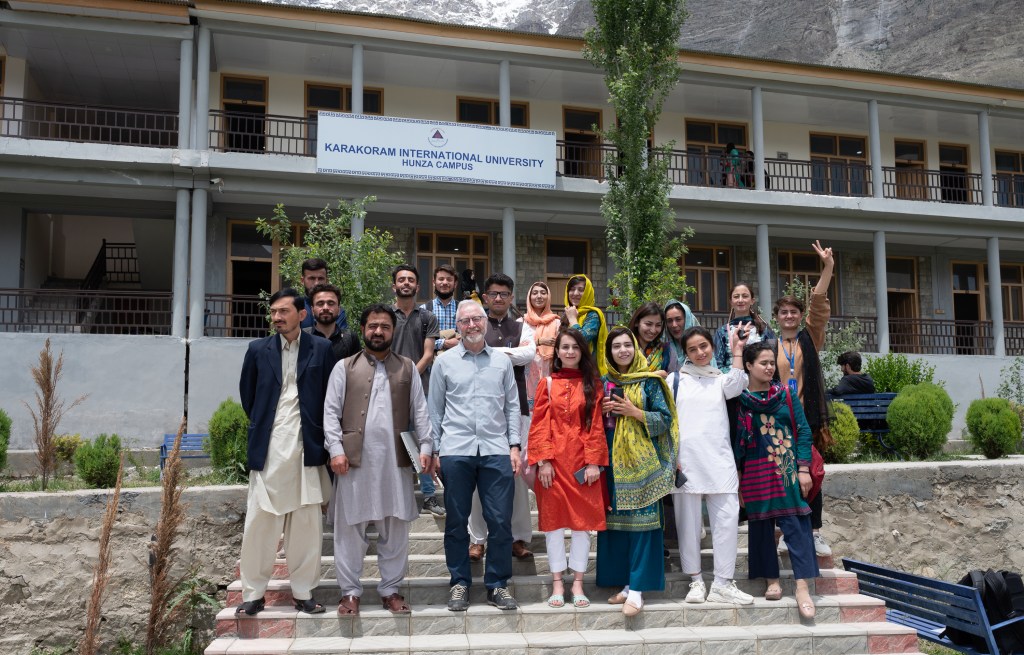
If you are a researcher at a Swiss or South Asian university or research institution working in sustainable development, the mobility subsidy may be for you!
The Cluster of Cooperation (CLOC) Knowledge2Action (K2A) has supported a wide range of projects on environmental sustainability and social well being, and has led to the generation of contextualised scientific knowledge for the advancement of sustainable development goals (SDGs). More so, it supports and encourages co-creation of knowledge with people and communities concerned with the changing reality imposed by the ongoing and expanding socio-environmental crisis.
Through this subsidy, K2A seeks to facilitate exchanges of and collaborations between researchers in Switzerland and South Asia and within South Asia. The intention is to promote knowledge production and circulation in the domain of sustainable development in South Asia and Switzerland that is community-based and/or directly policy relevant. K2A subsidies are available to support mobility of researchers within South Asia, from South Asia to Switzerland, and from Switzerland to South Asia. The mobility subsidy can be used to carry out field visits, research collaborations, concrete implementation of research results and/or teaching initiatives.

How do these subsidies help researchers expand their borders?
How do host universities benefit from these exchanges?
Why are these collaborative initiatives needed?
Read about the mobility experiences of previous subsidy winners here!!
Who can apply for the mobility subsidy?
Early career researchers (including PhD students) and senior researchers from universities in South Asia (Bangladesh, Bhutan, India, Nepal, Pakistan, and Sri Lanka) who would like to pursue fieldwork, research and/or teaching at:
- a university or research institution in another South Asian country
- a Swiss university or research institution
Early career researchers (including PhD students) and senior researchers from Swiss institutes of higher education or research institutions who would like to pursue research and/or teaching in South Asia
The fund awarded as part of the mobility subsidy will be dependent on the duration of the research stay.
Participation requirements
- Applicants must choose a host institution for the entire period of the subsidy.
- Senior researchers must give one to three lectures, seminars or a workshop at the host university during the mobility subsidy period.
- Applicants must provide a support letter from the supervisor or collaborator of the host university which details the level of support given by them during the research stay. This invitation letter from the host university should specify the scope of research collaboration and the teaching/workshop/lecture elements the visitor would be engaging in. Additionally, it should contain details on research infrastructure like desk space, access to research equipment and the research ecosystem like access to the local network, and access to knowledge resources (access to the library, journal access etc) during the research stay.
- The period of research stay must be a minimum of 3 weeks. The subsidy is available for
- South-South (Flight + 20 CHF per diem subsidy up to a total of 1000 CHF),
- South-North (Flight + 100 CHF per diem subsidy up to a total of 4200 CHF),
- North-South (Flight + 20 CHF per diem subsidy in up to a total of 1700 CHF).
- The applicant must demonstrate the capacity to co-finance the mobility either via the host institution or other research funding, including other grants. This can also include in-kind contributions like accommodation and food allowance.
- For mobility within South Asia, the applicant or the host needs to be a member of the K2A network, while membership to K2A is not a criterion for mobility between South Asia and Switzerland.
How to apply
Applications must be submitted via the K2A google forms with the following documents:
- Letter of motivation
- Curriculum vitae
- Letter of support from the supervisor/collaborator sat the host university that is co-signed by the head of department (or equivalent)
- Action plan for the duration of stay
- Proposed budget for the research subsidy (including travel allowance and weekly expenditure)
Kindly compile the five requisite documents into a single pdf file in the mentioned order.
The application must contain all mandatory documents requested.
Mobility Grant Winners 2022
- Ghulam Haider, National University of Sciences and Technology
- Nishara Fernando, University of Colombo
- Peter Marty, Zurich University of Applied Sciences
- Manish Kumar Jha, Tata Institute of Social Sciences
- Rajeev Kumaramkandath, CHRIST (Deemed to be University), Bangalore, India
- Meeta Keswani Mehra, Jawaharlal Nehru University
- Mohamed Esham, Sabaragamuwa University of Sri Lanka
- Devashish Saurav, Ashoka University
Mobility Grant Winners 2024-2025
- Saumya, Indira Gandhi National Open University (IGNOU)
- Fahis KT, Centre for Conservation Ecology & Department of Zoology, M.E.S Mampad College
- Jasnea Sharma
- Md Faisal Imran, University of Liberal Arts, Bangladesh
- Emon Nandi, Tata Institute of Social Sciences (TISS)
- Ajeet Pankaj, Indira Gandhi National Tribal University
- Jamie Allen, Critical Media Lab Basel
- Malith De Silva, Federation of Sri Lankan Local Government Authorities
- Sylvia Garcia Delahaye, University of Applied Sciences and Arts in Western Switzerland (HES SO – HETS)
- Muhammad Zafar Khan, Karakoram International University
- Jiban Poudel, Tribhuvan University
- Phillippe Foret, School of Management, Fribourg
- Shazia Jabeen, Women University Multan
 Knowledge2Action